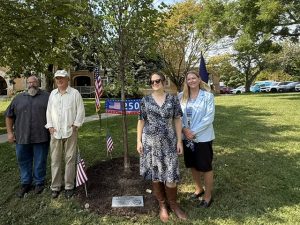
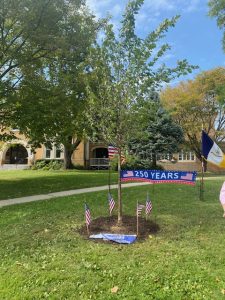
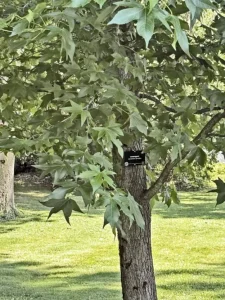
The Greenwich Tree Conservancy (GTC), together with the Sons of the American Revolution (SAR) and the Town of Greenwich, planted a Liberty Tree—an American elm—in front of the Greenwich Board of Education on September 17 to commemorate the 250th anniversary of the founding of the United States and honor Greenwich residents who fought for American independence. The tree was donated by GTC, with David Wold of the Connecticut SAR leading the planting. GTC Executive Director Kate Dzikiewicz highlighted the American elm’s potential to live for more than 250 years, making it a living connection between generations, and noted that surviving elms symbolize resilience, growth through adversity, and hope for the future. The ceremony also included the reading of a proclamation declaring September 17, 2026, as 250th Constitution Day in Greenwich, with Town Parks & Recreation representative Jonathan Fasone and Superintendent of Schools Dr. Toni Jones in attendance.
The Greenwich Tree Conservancy joined the Sons of the American Revolution and the Town of Greenwich in dedicating a newly planted American elm in honor of the 250th Anniversary of the Founding of the United States and the Greenwich residents who fought for American independence. The planting was held September 17 in front of the Greenwich Board of Education.
Kate Dzikiewicz, executive director of the GTC, spoke about how the tree serves as a living tribute to the past while offering shade, cleaner air, wildlife habitat, and beauty for generations to come. With American elms capable of living for more than 250 years, she said that this tree could one day stand as a reminder of our community’s history when future generations celebrate America’s 500th birthday.
Here is Kate’s full speech:
Today, we are proud to join the Sons of the American Revolution and the Town of Greenwich in dedicating this newly planted American elm to the 250th Anniversary of the Founding of the United States, and in honor of the Greenwich residents who fought for American independence.
I can think of no better way to commemorate America’s 250th anniversary than by planting a tree. We humans may live for only a century, but trees can thrive for generations. They become part of the landscape of our lives and communities, connecting us to those who came before us and to those who will follow.
With proper care and attention, an American elm can live for more than 250 years. It is entirely possible that this very tree could still be standing here when the people of future Greenwich are gathering to celebrate America’s 500th birthday.
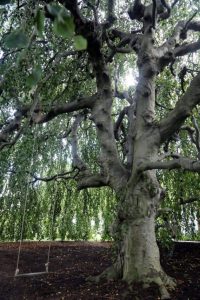
Over the past year, the Greenwich Tree Conservancy has been searching parks, streets, and private properties throughout Greenwich for trees that were already here when our nation was founded. I’m proud to say that a number of these remarkable trees are still standing.
The people who planted those trees could not have imagined the community that would grow around them, or the generations of people that would sit beneath their branches.
This elm will now begin its own journey through history.
As it grows, it will give shade, shelter, and cleaner air. It will provide habitat for birds and other wildlife, and it will add beauty to this landscape. But perhaps most importantly, it will serve as a living reminder of the people and ideals we are honoring here today. There is also something especially fitting about choosing an American elm for this occasion.
American elms were once among the defining trees of the American urban landscape. Dutch elm disease devastated elm trees across the country, yet some survived and endured.
To me, these survivor elms are symbols of resilience, that even when faced with challenges, we can meet them and grow on. We hope that the elm planted here today will become a similar symbol, of growth through adversity, of a community coming together beneath green leaves, and of the promise of a future yet to come.
Our Executive Director Kate Dzikiewicz recently wrote an article for the Greenwich Sentinel on the important role Greenwich’s trees play in protecting the health of its beaches and the Long Island Sound.
Byram Beach has experienced 118 bacteria-related closures between 2015 and 2025, and its sheltered location makes it harder for polluted water to clear. During rainstorms, runoff from roads, roofs, parking lots, and sidewalks carries pollutants such as oil, pesticides, fertilizers, pet waste, and sediment into storm drains and waterways. Trees help reduce this pollution by intercepting rainfall, allowing water to soak into the ground through their roots, absorbing certain contaminants before they reach nearby waters.
Byram and Chickahominy have some of Greenwich’s highest population densities and lowest levels of tree canopy, making the preservation of mature trees especially important. Although the Greenwich Tree Conservancy is working to expand tree cover through its public tree planting program and Byram Branches initiative, limited planting space and continued tree removal during construction present challenges. The article encourages Byram property owners to consider the broader community benefits of mature trees before removing them. Protecting and planting trees today helps support cleaner water, healthier beaches, and a more resilient coastline for future generations.
Last week’s Greenwich Sentinel article, written by Anne W. Semmes, recounts our recent Byram Park tree walk led by Greenwich Tree Conservancy arboretum curator Lisa Beebe, with GTC board member and landscape architect Matt Popp, and Byram Neighborhood Association member Al Shehadi.
Beebe used informational cards for each tree, allowing participants to learn about a species before discussing it with the group. The article emphasizes just how much work Beebe has done throughout Greenwich: she has labeled approximately 1,400 trees in the town’s parks, schools and libraries.
Read the full article in the Greenwich Sentinelhere.
Cheryl Dunson, GTC advisory board co-chair, recently wrote an article for the Greenwich Sentinel highlighting the many ways trees enrich our lives—not only by providing shade, cleaner air, wildlife habitat, and beauty, but also by becoming part of our community’s memories and history. She shares inspiring stories of treasured trees that have been passed down through generations, helped define a property, or marked important life moments.
The article also invites Greenwich residents to nominate a special tree for the Treasured Trees Contest by August 1. Trees on private property may be nominated for their history, beauty, size, age, unique character, or personal significance, with winning trees recognized at the Treasured Trees Celebration this October.
Read the full story in the Greenwich Sentinelhere.
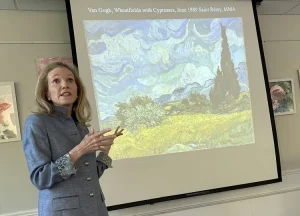
Nearly 30 attendees gathered for our recent Branching Out: Trees in Contemporary Art lecture with art historian Dr. Page Knox, held at the Greenwich Botanical Center, our co-partner for the event. Dr. Knox explored how artists have used trees not only as subjects, but as powerful symbols of resilience, identity, spirituality, hope, and humanity.
From the oak forests that inspired early conservation efforts in France to Vincent van Gogh’s emotional connection with cypress trees and contemporary artists addressing environmental and social issues through tree imagery, attendees discovered how trees have shaped artistic expression across generations. Dr. Knox concluded with the work of David Hockney, whose vibrant paintings celebrate trees as symbols of connection, family, and our relationship with the natural world.
Dr. Knox reminded us that trees can speak about environmental challenges, the passage of time, and the human experience itself.
Our recent article in the Greenwich Sentinel explains the rights and responsibilities of Greenwich residents when utility companies perform tree pruning or removal near power lines.
While utilities have the authority to maintain vegetation within utility protection zones and public rights-of-way to ensure electrical safety, property owners retain important rights when trees are located entirely on private property. Utilities must generally provide advance notice before planned work, and homeowners have the right to ask questions, discuss alternatives, and request that any agreed-upon modifications be documented in writing.
Residents are encouraged to review notices carefully, understand where their trees are located relative to utility easements and rights-of-way, take photographs before work begins, and communicate proactively with utility representatives. Understanding these rights can help protect valuable trees while supporting safe and reliable electric service.
Greenwich Sentinel / By Anne W. Semmes / May 1, 2026
Since the year 2007 the Town of Greenwich has been graced with a nonprofit effort to enrich, enhance, and add to its trees and forests, “to benefit our health and quality of life.” So read the invitation to the Greenwich Tree Conservancy’s (GTC) annual “Tree Party” benefit held traditionally at the McArdle’s Greenhouse as of last Friday week. And this year the “Tree Party” fell on Arbor Day!
The theme this year was “Flight of the Forest” with some 180 attending ticket holders bringing with their contributions “more trees in our town and enhancing the habitat that lets local and migrating birds sing.” That promise was fulfilled: “You’ll connect with neighbors, who also want to protect our town’s natural heritage and support the vital work of preserving and enhancing our precious tree canopy.”
Colorfully dressed attendees were happily gathered together and surrounded by an aromatic array of extraordinary flowers as GTC Board President Elizabeth Hopley greeted guests. “Happy Arbor Day everyone, delighted to see you all here! Thank you all so much for coming and supporting the Tree Conservancy.” And she thanked James McArdle “and his wonderful team for this always lovely venue.” Her “huge” thanks included such sponsors as
the Peter Malkins, Dave Williams, and U.S. Senator Richard Blumenthal and wife Cynthia Malkin Blumenthal, Bartlett Tree Experts, Sam Bridge Nursery & Gardens, “and Val’s Putnam Wines & Liquors, who generously donated the delicious wines and spirits tonight.”
By Greenwich Sentinel / Featured Article / April 23, 2026
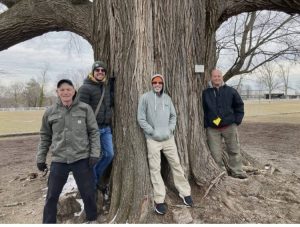
A group of residents stood beneath a towering Japanese white pine on a recent March afternoon, watching as a small team measured its trunk and canopy with practiced precision. The demonstration, part of the Greenwich Tree Conservancy’s Notable Tree Program, drew attendees to the Greenwich Botanical Center.
The gathering focused on something easy to overlook in daily life: the trees that have stood in place long before the town’s roads, homes, and schools were built. These trees, some of them recognized as the largest of their kind in Connecticut, have become markers of both time and stewardship.
Greenwich is well-represented in the database, with 208 trees total, of which 151 are confirmed to be extant. 32 are champion trees and 12 are co-champions, meaning that they were determined to be the largest examples of their kind found in Connecticut. To find out more about the Connecticut Notable Trees project go to: https://oak.conncoll.edu/notabletrees/
The program maintains a database of significant trees across Connecticut, and Greenwich holds a prominent place within it.
Frank Kaputa, co-chair of the statewide Notable Tree Program, led the presentation alongside team members John Kehoe, Marty Aligata, and Kyle Dougherty. Over the course of an hour, the group outlined how trees are identified, measured, and cataloged, and why the effort has grown into a statewide resource.
As I write this, it seems that winter’s bitter cold and snowy grip is loosening. Daffodil leaves are pushing through the soil, birdsong can be heard intermittently, and trees are starting to bud. While Greenwich is a beautiful town at all times of year, arguably Greenwich seems at its loveliest in spring with the canopy filled with a lovely array of white, pink, and red flowering trees.
It almost seems miraculous when reflecting on what the trees had to endure this winter. Trees are a marvel in so many ways. It got me thinking about books where trees are a focus that have informed and/or inspired me. And then I wondered about what books may have informed and/or inspired my board and advisory board colleagues at the Greenwich Tree Conservancy. I decided to ask them. Below is an admittedly idiosyncratic list of fiction and non-fiction tree related books that we have enjoyed. We hope you do too!